

The Version You’ve Probably Heard About
When most people Google vipassana, they find two things: ten-day silent retreats, and accounts of how hard they are.
No phone. No talking. Wake-up bell at 4am. Twelve hours of sitting per day. Sobbing on day five. Life-changing on day ten.
This is a real and valuable tradition. I’m not dismissing it. But it’s also a significant barrier for someone who just wants to understand what vipassana actually is and whether they can try it without setting aside ten days.
The answer is yes. Vipassana — insight meditation — is a practice you can start in the next ten minutes. The retreat is an intensive version of something you can do in ordinary life, in ordinary clothes, at your desk if needed.
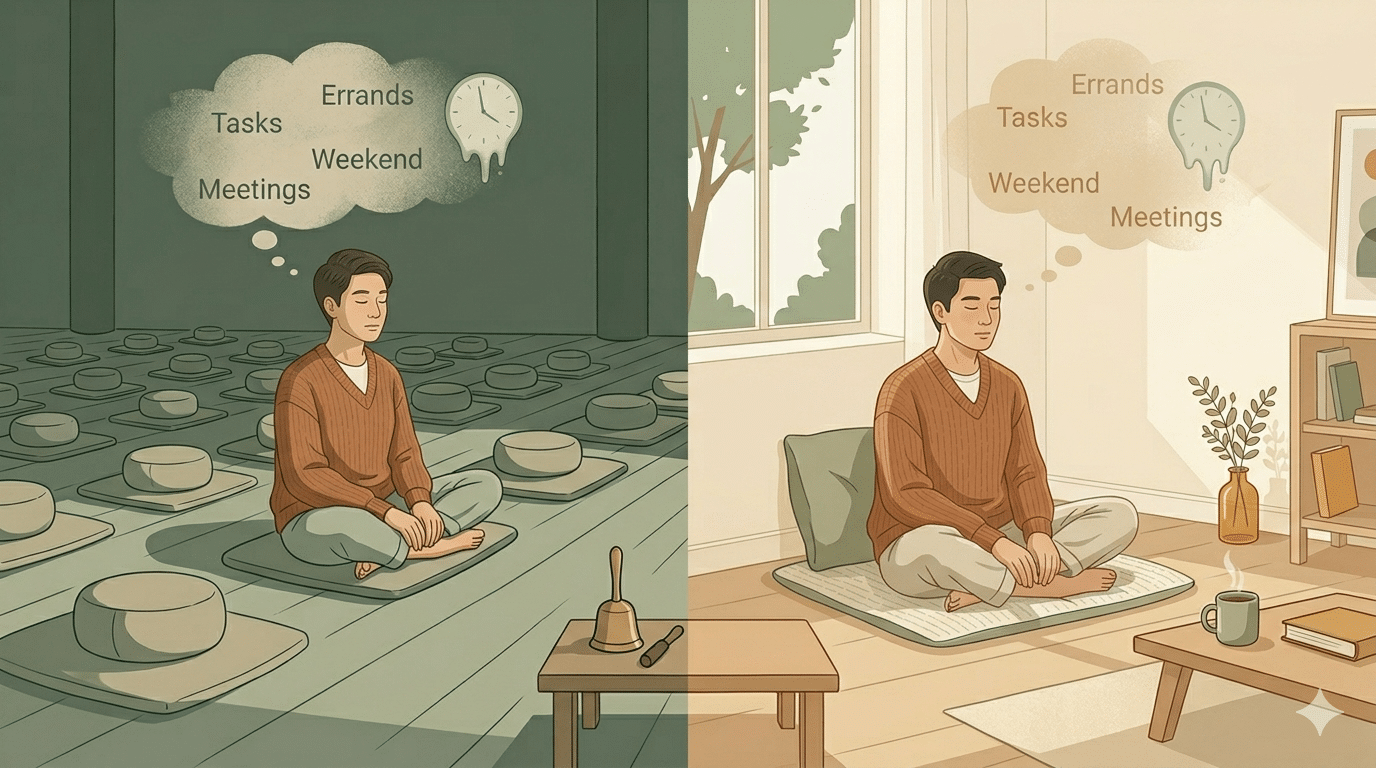
What Vipassana Is (and What It Isn’t)
The word vipassana is Pali for “clear seeing” or “insight.” It’s the second of the two core Buddhist meditation practices — the first being shamatha, or calm-abiding.
The goal of shamatha is stability: a trained, settled attention. The goal of vipassana is insight: using that settled attention to look clearly at what’s actually happening in your mind and body, moment by moment.
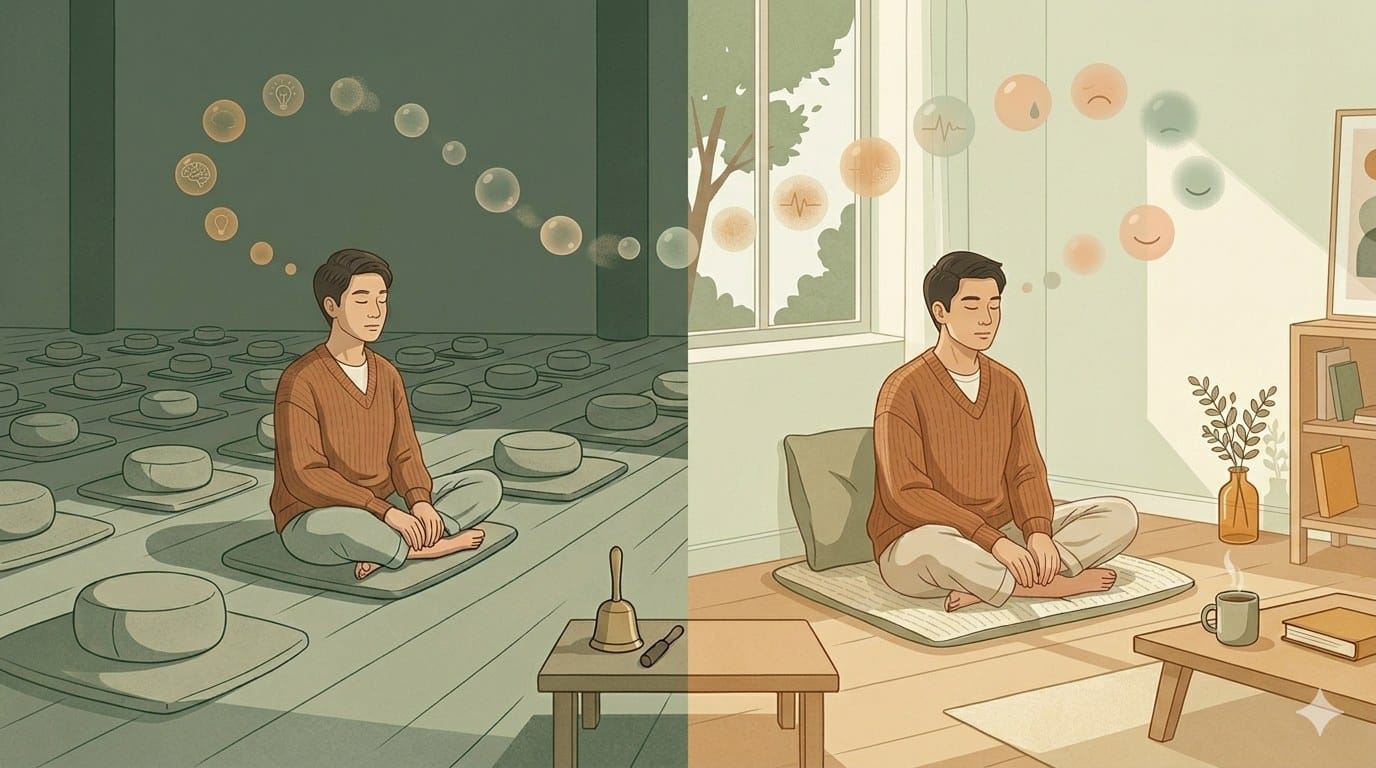
What you’re looking at, specifically, is impermanence — what Buddhists call anicca (pronounced ah-NI-chah). Thoughts arise. They pass. Emotions appear. They dissolve. Sensations flare up. They fade. The practice is training yourself to actually see this in real time rather than being swept through it automatically.
The practical payoff: when you can watch a thought arise and dissolve — when you’ve seen it happen hundreds of times in a sitting — it becomes harder for any single thought to completely dominate your experience. The anxious spiral doesn’t stop happening. But you get faster at recognizing it as a pattern instead of a verdict.
Why Shamatha Comes First
If you’ve been practicing with a meditation app, you’ve likely been doing a form of shamatha: focus on the breath, return when you wander. That’s the foundation.
Vipassana without shamatha is like trying to read by candlelight in a hurricane. The investigation requires a mind that’s stable enough to actually observe what’s happening, rather than getting immediately pulled into whatever arises.
The traditional sequence: develop enough shamatha to hold a reasonably stable focus (this takes days to weeks of consistent practice, not years), then begin introducing vipassana. In practice, most experienced practitioners move fluidly between both in the same session.
If you’re brand new to meditation, start with a simple breath meditation for beginners first. A week or two of that makes vipassana significantly more accessible.
If you’ve already been sitting regularly — even on an app — you likely have enough foundation to start.
The Noting Practice: Vipassana for Beginners
The most accessible entry point into vipassana is a technique developed by the Burmese teacher Mahasi Sayadaw called the noting practice. It requires no special equipment, no retreat, and no prior experience beyond basic breath awareness.
Here’s how to do it:
1. Start with five minutes of shamatha. Sit upright, close your eyes, find your breath. Focus on the physical sensation of breathing — the rise and fall of your chest or abdomen, the feeling of air at your nostrils. When your mind wanders, notice it wandered and return. Do this for five minutes.
2. Open your attention. After five minutes, let your focus soften. Instead of anchoring exclusively on the breath, let your attention be available to whatever is most prominent in your experience — a sound, a thought, a physical sensation, an emotion. You’re not hunting for things. You’re just waiting to see what arises.
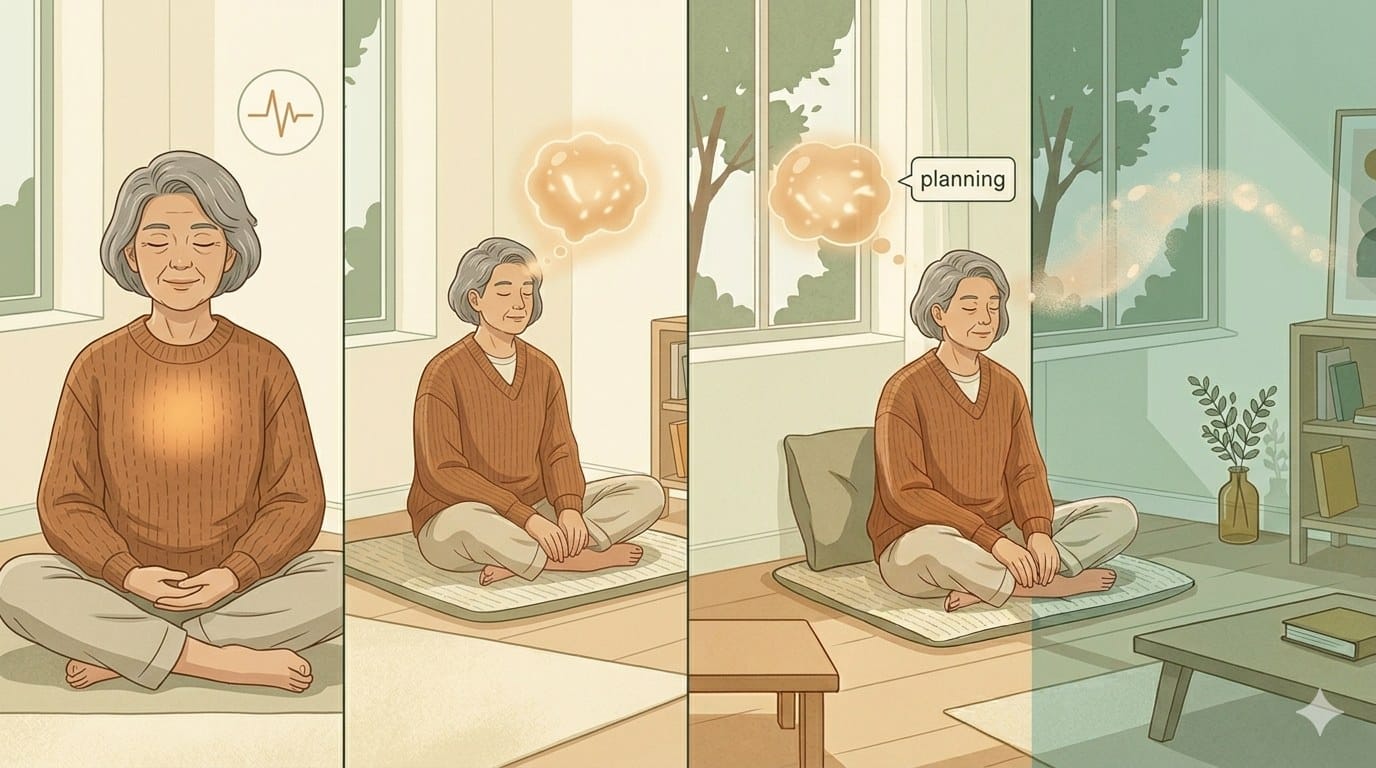
3. Note what you notice. When something arises, silently label it with a single, neutral word. A thought about tomorrow: planning. A tightness in your shoulders: tension. Frustration that you’re not doing this right: judging. The sound of a car outside: hearing. Curiosity about whether you’re doing it correctly: wondering. Just one word. Quiet and internal. Then let it pass.
4. Return to the breath between notes. The breath is your anchor. When nothing strong is arising, rest there. When something pulls your attention, note it, and return.
5. Continue for ten to fifteen minutes. The practice is the noting itself — the gentle, neutral labeling of each experience as it appears. You’re not trying to make anything happen. You’re observing what’s already happening.
What You’ll Actually Notice
The first few sessions of vipassana tend to feel one of two ways: either profoundly boring (nothing seems to be happening), or overwhelmingly busy (there’s too much happening to note).
Both are correct responses. What you’re noticing is what’s always been there.
My first real vipassana sit felt like the second one. I stopped after four minutes because my mind felt like a broken fire alarm — not something I could observe, just something I was trapped inside. I sat again the next day for the same reason I debug something that crashes: I wanted to know what was actually happening in there.
The “too busy” experience is especially common for overthinkers and people who spend their days in high-cognitive-load environments. The mind has been running fast for years. Sitting still and watching it for the first time is like suddenly noticing how loud a room was after someone turns off the background music.
The noting practice slows this down. Labeling creates a small but significant gap between experience and reaction — between the thought and the response to the thought. That gap is what you’re training. It starts small. You might only notice it for a fraction of a second. Over time it gets wider.
Am I Doing It Wrong?
“I keep getting lost in thoughts instead of noting them.” This is the practice. Every time you realize you’ve been lost and return to noting — that moment of recognition — is the practice working. The practice isn’t staying perfectly aware. It’s repeatedly returning to awareness.
“My notes feel mechanical and robotic.” Good. The neutrality is the point. You’re not narrating your experience; you’re categorizing it at arm’s length. It will feel clinical at first. That clinical quality is what creates the distance from thoughts that vipassana is building.
“Nothing feels different. I don’t feel calm.” Vipassana isn’t primarily a relaxation practice — that’s shamatha’s job. Vipassana is an investigation. Some sessions will feel uncomfortable. Some will produce unexpected clarity. Some will feel completely pointless. The variation is part of it. What you’re building doesn’t show up during the session; it shows up when something difficult happens at 2pm on a Tuesday and you notice you have slightly more space than you used to.
“Is this the right way to do vipassana? Aren’t there other methods?” Yes — there are many vipassana lineages. The Mahasi noting practice is one of the most accessible for beginners because it gives you something concrete to do with attention. Goenka retreats (the ten-day ones) use body scanning instead of noting. Both are legitimate. The noting practice is a reliable starting point.
How to Build from Here
Consistency matters more than length.
The most practical advice: keep sessions short enough to do consistently. Fifteen minutes of vipassana five days a week beats ninety-minute sessions twice a month. The practice builds on itself through repetition, not duration.
Over weeks, you’ll notice the noting becoming more natural — less effortful, more automatic. You may start noticing thoughts being labeled in daily life without intentionally sitting. That’s the practice working. The cushion is just where you rehearse what you’re learning to do everywhere else.
For more on building a steady sitting practice, see how to meditate for beginners.
The noting practice above is enough to start today.
Key Takeaways
- Vipassana doesn’t require a ten-day retreat. The retreat is an intensive version of a practice you can start in fifteen minutes at home.
- Vipassana means “clear seeing” — specifically, seeing the impermanence (anicca) of thoughts, sensations, and emotions as they arise and dissolve.
- The noting practice (developed by Mahasi Sayadaw) is the most accessible beginner entry point: observe what arises, label it with a single neutral word, return to the breath.
- Shamatha — basic breath focus — comes first. A few weeks of breath meditation gives you the stable attention that vipassana requires.
- The payoff isn’t calm during sessions — it’s more space between stimulus and reaction in daily life. The anxious spiral still happens; you just see it sooner.
- Signs it’s working: realizing you’ve been lost in thought faster than you used to. Noticing a reaction in real life before you’re fully inside it. None of this feels dramatic when it happens.
FAQ
How is vipassana different from regular mindfulness?
Modern mindfulness — as taught by apps and MBSR programs — is largely derived from vipassana but simplified into a general present-moment awareness technique. The original vipassana practice has a more specific goal: cultivating insight into the three characteristics of experience described in Buddhist teaching — impermanence (anicca), unsatisfactoriness (dukkha), and the absence of a fixed self (anatta). Secular mindfulness keeps the technique and removes the investigative framework. Both have value; the Buddhist version is more ambitious about what the investigation is for.
Do I need a teacher to practice vipassana?
For beginner practice — fifteen to thirty minutes of noting at home — a teacher is helpful but not required. The noting practice described above is well-documented and accessible enough to start independently. Where a teacher becomes important is if you sit for longer periods (over an hour) and begin encountering more intense experiences: strong emotional releases, unusual perceptual states, or extended periods of difficulty that Western practitioners sometimes call “the dark night of the soul.” These are within the range of normal practice but benefit from guidance. For most beginners building a daily practice, the greater risk is not sitting without a teacher — it’s not sitting at all.
How long before I notice a difference?
Most people who practice consistently notice something shifting within a few weeks — not dramatic transformation, but a slightly faster recognition of familiar patterns. The 3am spiral arrives and something says oh, this again a moment sooner than it used to. A harsh word lands and there’s a beat of space before the reaction kicks in. These small shifts are the practice working. They accumulate slowly and then, looking back after several months, feel significant.
New to meditation? Start with how to meditate for beginners, then come back to the noting practice.